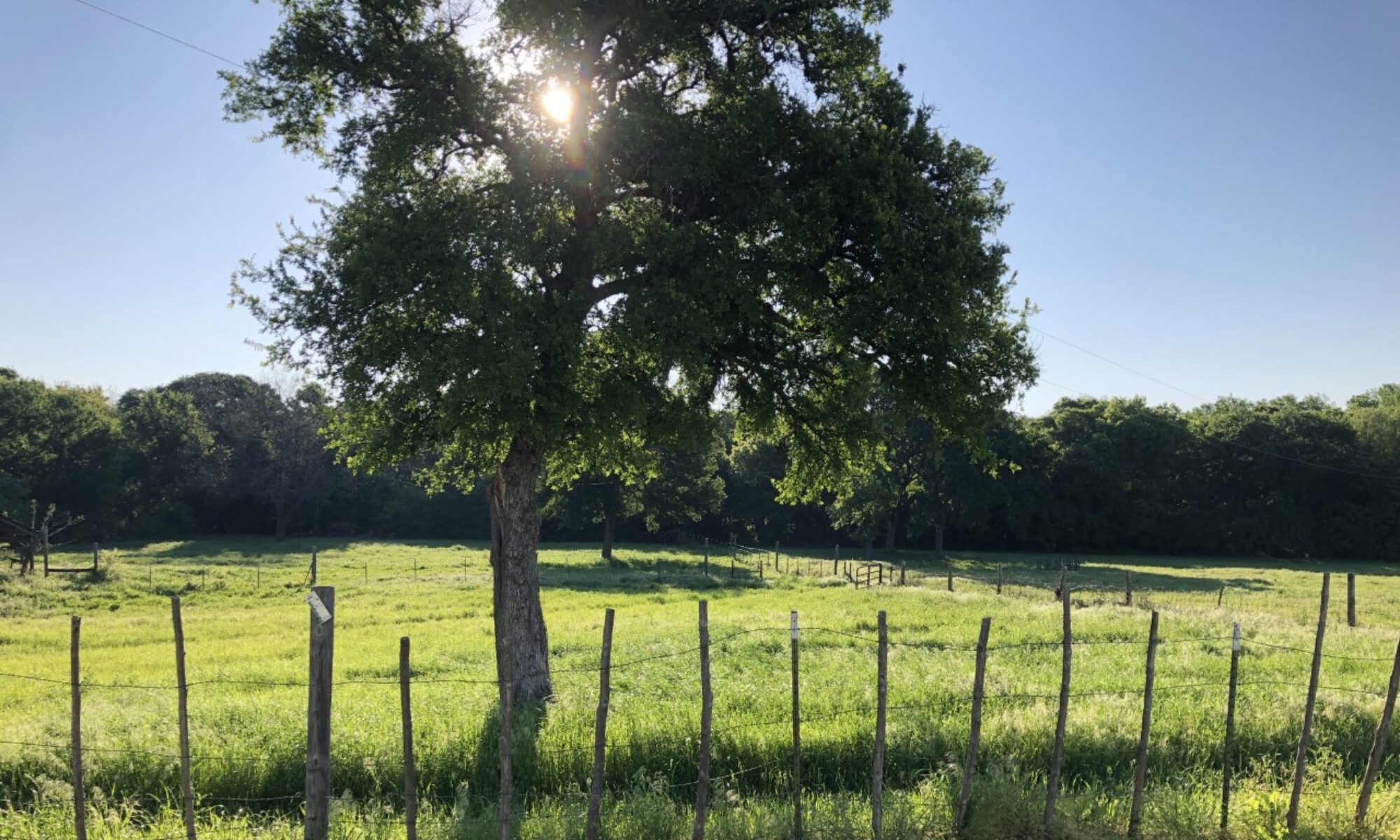
Spring is here. Beautiful time of the year. Everything springs to life. Doors and windows stay open. With the Four Seasons, noted time traveler Vivaldi captured a bit of this energy. Let’s see what’s happening with four movements here at Raising Wood.
Our open market economy sells trees in pots RIGHT NOW because everyone has the itch to plant them. Jenny is reworking a peach tree from 3 years ago in this picture. Cardboard base, heaping piles of mulch, and deep watering all go together. There’s fruit budding on this tree now and we should get our first harvest off it. Jenny also planted some fig trees and has plans for pear trees. There is a lot of excitement about future harvests around here, even before we address the berry patch invitations.
Mesquite trees are a pain. Literally, full of thorns. They grow in the pasture and need to be be taken out by hand. Or, alternatively, you can water around it and let pasture pigs waller around it to destroy it. The pigs like this option. So do I.
Goat mothers are interesting creatures. Dot here gave birth to twins. The boy is enormous and thriving. The girl is rickety and slow. Dot recognized this from birth. She triaged the situation by focusing all her care on the boy while comprehensively neglecting the girl.
Fortunately we’re accustomed. Now we have kidding pens to set up our own triage. Five days of keeping them separate from the herd. Four times a day forcing nursing sessions for the little girl. Three goats learning to be a family. Two determined shepherds. Now one self standing and self feeding girl goat. Success is satisfying.
2am. The flock guardian Ashok is barking in the pasture. Jenny investigates. Jenny sees the problem and rouses me from bed. There is a dead chicken in the meat bird tractor. Cause of death matches three chicks from four weeks prior. The head is fine, the organs are fine, the neck is fine. The legs and thighs are sliced into chicken burger and feathers are everywhere.
Turns out Ashok was barking at a 3ft tall owl. Jenny watched it sneak talons under the lip of the tractor to grab chickens l. When the chick was 12oz, it was a good snack. Now these birds are 7lb and they don’t fit under the frame. Owl doesn’t care and just tears off a talon full of thigh meat.
I can’t always tell when an owl will show up. I can add a PVC pipe flap on the gaps. They are working for a week now and no more sliced up birds.
Well, not til we process them in early May to fill the freezer, as is right and proper. Happy spring y’all.
He is indeed. Now there’s a bird nest behind this in the shop
I find carpentry projects relaxing, mechanical projects educational, and fencing projects routine. I have no experience with welding projects.
Message to Jenny after test run
(said in homage to the excellent show, Clarkson’s Farm) (this contains the most melodic fence post pounding you’ll encounter)
Then this particular mix of carpentry, mechanical, and fencing projects combined into a welding project. I set off down the YouTube rabbit hole of DIY welding. 2 hours later I was convinced I could totally do this, no problem, and the cheapest wire feed flux core welder at Home Depot would be fine.
Leaning right
This gate post was bent out of shape thanks to an aggressively growing tree. I cut the bars previously connecting it all together, and now pushing it all out of place. I used a come-along to pull the post back to vertical, then put overlap metal rods on the fence rails to tie it back together with sister joints. Then used the grinder to remove splatter and numerous sharp edges.
A fine, upstanding gate
Turns out, I was right, but not about what I was convinced of. The smallest cheap Lincoln kept throwing the 20amp breaker in the shop so I moved to generator power. Then the welder was undersized for the thickness of the metal and ran into thermal overload very quickly. Each time added a twenty minute cool down period.
After this project I returned the tool and sized up the the next one. Both problems solved. The welds are all ugly, and these kind of farm applications are great learning opportunities for my hands.
All projects need interruptions. Miss Molly Tamale the new puppy was happy to oblige by getting her head stuck in this fence chasing Hay Bale the barn cat during one of the shut downs.
The other end of the cattle run needed a control gate. Maple is quieter than steel and I need calm cattle. Now there’s also a loop I bent and welded for the sliding latch to anchor against. I am inordinately proud of this whole assembly, thank you very much.
The big win at the end of these upgrades is a cattle run to reliably load cattle onto the trailer. The picture above shows where the stock trailer will back up to, this is the gate opposite the repaired gate. Now they will pass through to either pasture or trailer, at our direction. The log is there to bridge the gap when the trailer is fully backed up.
It does work. We have done the three easiest loads ever over the last week while getting the AI process done on two cows.
I was also able to convert some old bedframe steel into a dolly for a pig feeder. One afternoon of messing around and a lot of convenience added to the pig feeding process. New welding skill, for the win. Headgate attempt is next.
Kids have been experimenting with locks and dams in the pasture, they got much better water retention then I expected Leveling up skills, matching these leveled up sunrises.
2024 was our smoothest year. After 4 years of tweaking, adjusting, improving and optimizing we had the lowest ratio of labor + chores : production yet.
The biggest improvement this year has been integrating two boys (now 7&9) into dog and chicken management. It is a daily task to manage feed and water for the Livestock Guard Dogs and the Hens, as well as collecting the eggs. They are compensated per egg, so it varies by the day. They are really quite good at it and I’m proud of their efficiency in the task.
We cleared a huge range of branches on the north end of the pole barn and replaced a broken gate system. While we did the replacing, we went ahead and moved the placement of the gate to better fit our trailer access needs. Incremental improvement!
You will notice the red Packout tool storage system on the 4×4, and also in this picture in the house while I remodeled the bathroom. Huge time saver, a lot less walking back to the shop and much faster access to each tool, because it always has a home. Even for a DIY Homestead grade guy like me, this system is worth the investment for the time savings.
On the topic of organizing tools: Love getting the extension cords off shelves and workbenches. Now there is a single hanging organization system, another incremental improvement that pays dividends. When it is time to string up cables for deicing water tanks, easy access to each cable.
Family nearby replaced their wooden garage doors. They kept the wood for me and I converted them into worktop and shelving space in the shop. Nice improvement in feed & supplement storage and access for a low cost. Milk crates fit perfectly in the second level, making organization on the shelves a success. It’s a wonderful feeling when the shop is a asset to walk into, not a liability you groan and try to avoid.
While we’re in the shop, let’s talk about these Enbighten wifi electrical outlets. Originally I installed motion detecting LED panels in the shop. The idea was they would auto off when I was not in there at night. It’s a great plan, except the cats keep the lights on most nights. The shining is annoying in my bedroom window. Now I can turn them on and off from an app on my phone. Additionally, I can manage the electric fence remotely from the phone. Find a break and need to fix it? Turn the fence off. Make the repair. Turn it on. Huge time savings for electric fence maintenance, easily dozens of hours in a year. Incremental Improvement!
Since we’re looking at extension cords, diligent children, and a home remodel, check this out. There’s a green extension cord on the right side of the driveway. That 300ft of connected cable is there because the boys wanted to get our Nativity scene set up at the end of the driveway. I was in the middle of fussing with replacing trim and said “go help me by getting the power lines out there.” They knew where the cables were in the shop and ran them out without assistance. They were proud of their work, and they should be. It was a great help and gave them skin in the game as we set up the Christmas lights together.
Looking at equipment that drags gear around, sometimes you just barely manage to finish chipping wood and get the tractor in the barn while the steam is blowing out the radiator. Not a great feeling, and this is going to be some time investment to find the root cause and remedy the overheating.
Since we’re in the barn, time for hay! We haul the cattle hay around on the utility trailer. To feed the goats, we tip a bale over and cut it open, then peel hay off to toss into the feeder systems. I just like this pic of the girl and the goats playing around, so now you get to see it too.
Jenny developed an incremental improvement to this feeder from last year. She salvaged broken halves of 5 gallon buckets to make a new hay base . This prevents the tiny bits of hay from packing together and cementing the bottom of this wire arrangement and encourages more comprehensive eating of the hay.
Another Jenny concept: Affixing sheet steel on the north end of the barn. This greatly improves the storm resistance of the goat area in the winter. In the summer there’s still plenty of cross breeze to keep it from overheating. This expands the functional area of feeding hay to the goats, resulting in a healthier flock over winter.
Down at the south end, the other half of the flock has its own area. Jenny’s idea (see the theme?) was to add a passthrough gate for the farmers to farm better. Now it has a gate. Incremental improvement worth 2 minutes a night for 100 nights each winter. That’s time well spent.
You may run the numbers in your head and say “Well Robert, that took you both 3 hours to arrange and install. That’s 6 man hours. Not a good investment, that is a 2 year return to your labor!” To which I will say, “any minute saved on a daily chore is a minute farther away from frustration, annoyance and burnout. Taking 3 hours on a nice Saturday to make this a joyful experience for the family year round is worth it. Or in economics terms, the opportunity cost of our labor every night is high compared to the opportunity cost of a slow and peaceful Saturday morning. See also, that smile up in the pic.” Incremental Improvement!
A picture of a kid with a kid with another kid in the background is a good segue to some of your questions following the latest chicken processing day:
Q: “The air drying: I had not heard that needs to be done, I assume this is because you give the birds all a good rinse and just want to keep that moisture off of them for freezing?”
A: Bird skin will struggle to crisp up if it’s frozen with soggy skin. Drip/air drying helps with that. Eviscerate on the table, spray off with a hose, dunk in water in a utility sink for 10-20 minutes. After it sheds heat in the sink we move to a cooler with ice. Target is under 40f within the hour. The joints will feel stiffer when cold. Then drip/air dry for 15-20 minutes with those stiff joints. I run a big shop fan on low to keep air moving over it gently. Longer is fine too.
Q: “For bagging, you’re not using a vacuum sealer or anything, but the bags look nice and tight to the bird. Are you just dipping the bag in water to push the air out and then sealing it?”
A: I fully recommend these, We use them because Neighbor J.P. uses them because he learned to use them on a nearby pasture poultry operation. 100% success rate for both of us. texaspoultryshrinkbags.com/products/10-x-16-shrink-bags Unless the bird is over 8lb, then we size up to the turkey bag. There’s a straw that goes into the bag in the cavity of the chicken. When you dunk in 195f water the plastic begins to shrink. Remove from water. Pull the straw out and tighten zip tie completely with pliers. Let the bag dry and then label with included labels, which have excellent adhesion.
One for the road folks! There’s always some Wood to raise in 2025, Godspeed on your endeavors.
Every man should make a work space. It will be a place where he goes to work. First with his mind to design, then with his hands to build, then with his heart to judge a project complete. Here he will bind what is broken and mend what is mangled. If he is wise he will do maintenance on his machines before they need repair. He will also teach others the skills he sharpens in this place. There is a reason that every good Role Playing Game has a good work area. The aspirational hero will forge new weapons and craft protective armor, it connects to the soul of man.
If he is really blessed, it will grow into a workshop. A workspace is a place you sit, a workshop is a place you can walk. He will have workstations in the shop, designated storage, and focused lighting. Invariably he will be at one workstation and say “aaaigh, I need that tool be ready right here”. It could be a measurement tool, a screwdriver, maybe a change of blades. He will consider his situation and be sad he did not have a way to easily and conveniently put task relevant tools in reach.
There’s a cheap solution. Let me show you with some real life pictures:
Sawzall blades have a easy swap spot, Allen wrench at the end tightens a specific clamp.
The good news? For $3 at Harbor Freight, he can make a massive upgrade to his work space and workshop.
Cut off bolts, change of utility blades at the vise station.
Magnetic bars. 18 inches of working space. Screw holes on the ends. Easy install. You will notice these are placed near the corners of the workspace to be easily accessible from both sides of the corner.
Layout tools by the table saw. Putty knife at glue work space. Random wrench for…I don’t remember.
https://www.harborfreight.com/18-in-magnetic-tool-holder-60433.html, no affiliate link.
Handy for securing steel chests without permanent installation requirements.When the work is over it’s good for recreational applications
Give it a try or give these as a gift. They punch way above their weight class in terms of permanent utility per dollar spent.
On the homestead we are accustomed to being in good health and working on projects together. The transition from summer to autumn did not feature that this year.
We expanded the family with a newborn girl in September. Momma has been dedicated to making the most of this special time, and it’s awesome. The driving choice behind the Raising Wood homestead is making space for children to grow in a space to develop character. More children means more opportunities, within the farm context and within the family. Jesus is good.
We had a wonderful thunderstorm roll through and drench the land with rain. It featured 42mph winds and took out tree branches all over the property. In the process of clearing branches I thoroughly messed up my shoulder and elbow. Turns out a cordless sawzall can out work my body.
As a result there’s been a great deal of inside the house, lightweight work. I finished building and installing some cabinets, painted some doors, ect. Then some small projects outside with easy objectives. Here are some of them over various Saturdays:
This is a new goat feeder. PremierOne has some designs for sale, I bought the design and modified it for our space. It is higher thank our existing feeder and has a larger tray under the hay to capture more pull through material. Also has wood down low to stop goats from scampering underneath.
A different weekend was replacing the roof on the chicken tractor. Out with soggy wood and shingles, in with sheet steel. Stronger, lighter and more durable. Tiger Lilly the Lady Kitty insisted on having input. I think the eclipse was bothering her so she needed people time. Working outside for the duration of the eclipse was a neat family experience. We also started getting wheels together for a push cart for the kids, everyone got a lesson in using pilers and the power of PB Blaster to break some shafts free.
Next weekend was chipping away at the past 3 winters of build up off the barn floor. A 4×4 and trailer helped make quick work of transportation. We scattered the rich fertilizer material in dead spaces in pastures. The combo was also handy for moving the feeder.
We placed the feeder in one spot. Then reconsidered . Then moved it. Then again. Then we set up a partition wall. This will separate different herd matriarchs from one another and lower herd stress for feeding.
Even better, there’s a secret hiding space for adventurous small goats under the feeder. The feeder which was designed to keep goats from getting under it. Such is the goat.
Small steps add up. Happy to be able to keep moving forward and optimizing work flow. The goal is to make the winter chores quick and easy every night.
Cabinet build and install nearly finished in this picture, it has been well received in its place and fully integrated into the kitchen.
We moved all the hens into the A-frame chicken tractor, and we have some chicks who need a new home out on the grass. While our original mobile chicken coop was empty, it is time to make some repairs.
Have grinder, will travel
It was a laundry list of small repairs. Rusted metal with holes that needed patching in the roosting box. Metal screens detached from the frame thanks to some grain hungry goats shoving their heads in. Wheel frames bent and making it difficult to pull around. Broken ramp to climb into the roost box. Roosting bars unattached and falling everywhere.
Ready for chicks
Wonderful fall weather made the entire process fun and enjoyable. Somehow we did the entire batch of repairs in perfect harmony, not a single disagreement on how or what to do. These are good days.
We built a second version of a chicken tractor for the incubator champion chickens and moved them outside to the grass.
The design is heavily influenced by the ubiquitous Joel Salatin builds from Polyface Farms. Since we had a truck bed liner salvaged from a neighbors trash, we used it for the canopy in the back.
Every day this gets moved to a new patch of grass, the food bucket is checked and the water is managed. Protection from predator and wandering off while befitting from the pasture and fertilizing the grass. Wins all around.
Last winter we spent a lot of time managing goat and cow hay when it got cold. To clarify cold, it’s when I have to change how I manage livestock water. If it’s going to be solid on top through lunchtime, it’s cold. In the barn area we can manage water much easier then out in a pasture.
So, when the weather is right, into the barn they go. Barns do not grow grass well. So we feed hay. Hay on the ground is a waste, hay in a feeder is money well spent.
So we made a feeder that looks like a barrel, if a barrel was made of 4×4 inch mesh panel. Cheap, effective… Annoying because the goats keep smashing it in on itself.
We noticed another problem: the big queen goats kept all the other girls off of ‘her’ hay. The bucks are always welcome to get hay, just none of these other lady goats. With the impression of artificial scarcity, the whole herd suffered.
Canine approved
They make commercial grade feeders and sell them at ag stores, specifically for goats. They bite hard into our profits, so I was reluctant to buy one. But listening to sad lady goats bawling about being cut off from hay convinced me something must be done.
We go to the AG store, braced to pay full price. “What’s that? Oh you don’t have any. “
Off to the next ag store… “What’s that? You don’t have any either?” Hmmm.
“Wait, what’s that? That gnarled and faded piece of gear hanging off your fence back here? Yes, it sure is damaged. Yes it sure would be some work to make it usable. What’s that? You’ll sell it for 80% off? … Yeah I guess we can do that, if you insist.”
So after hammer work on the metal and mounting work on scrap wood (keep it for a reason!) and left over tote lids… We got ourselves a feeder for less then half price.
“Look, human, it is empty”
It works. It works even better then my barrel contraption because they eat the seeds on the tray as well.
Part of the fun in homestead farming is the power tools. Drills, impacts, sawzalls…and tractors running a woodchipper.
Craigslist Find
Winter is coming and after the deep freeze last year, no more joking around for us. The pole barn is being rearranged to optimize space. Animals will stay on concrete floor areas for easy cleaning. Then we will be keeping hay separate from the animals.
The Steam Also Rises
The plan is inspired from some Joel Salatin writing on the wonders of using wood mulch as bedding in the winter. It soaks up the free fertilizer and can be converted to soil. To help the conversion in the spring, you put some corn in between your layers of mulch. Then the pigs dig up the corn and aerate the mulch in the spring. To do this, we need more chips.
Woodchipper on the three point hitch
Jenny has thought a woodchipper was a good idea for months. Over the summer she had a Don Quixote fixation with cutting tree branches down. They helped to feed leaves to the goats. It also helps grass grow under the trees to get more sunlight to the ground under the canopy.
Between that effort and the brush clearing to fix fences last year and this year, we have wood to burn.
Or in this case, chip into mulch, scatter as bedding, scatter some corn kernels amongst the bedding, put more mulch on it, then turn the pigs loose to till it all up into fluffy garden soils for the spring.
I have been excited about this. It’s a dirt scoop and it moves on the three point hitch. It scoops and dumps dirt. It’s what the ancients used before front scoops replaced them with vast improvements in utility.
What does it do? It’s a scoop you lower down behind you to scrap up material. Then you go where you want to go and pull the rope and dump out the material. In this case, it is mighty fertile mulch for some bare spots and for the fall garden.